A practical pronunciation routine
Good pronunciation comes from three things working together: your ear, your mouth, and feedback. If you only repeat words without hearing the difference, you may reinforce the same mistake. If you only listen, your mouth never builds the muscle memory. If you never get feedback, you may not know what to fix.
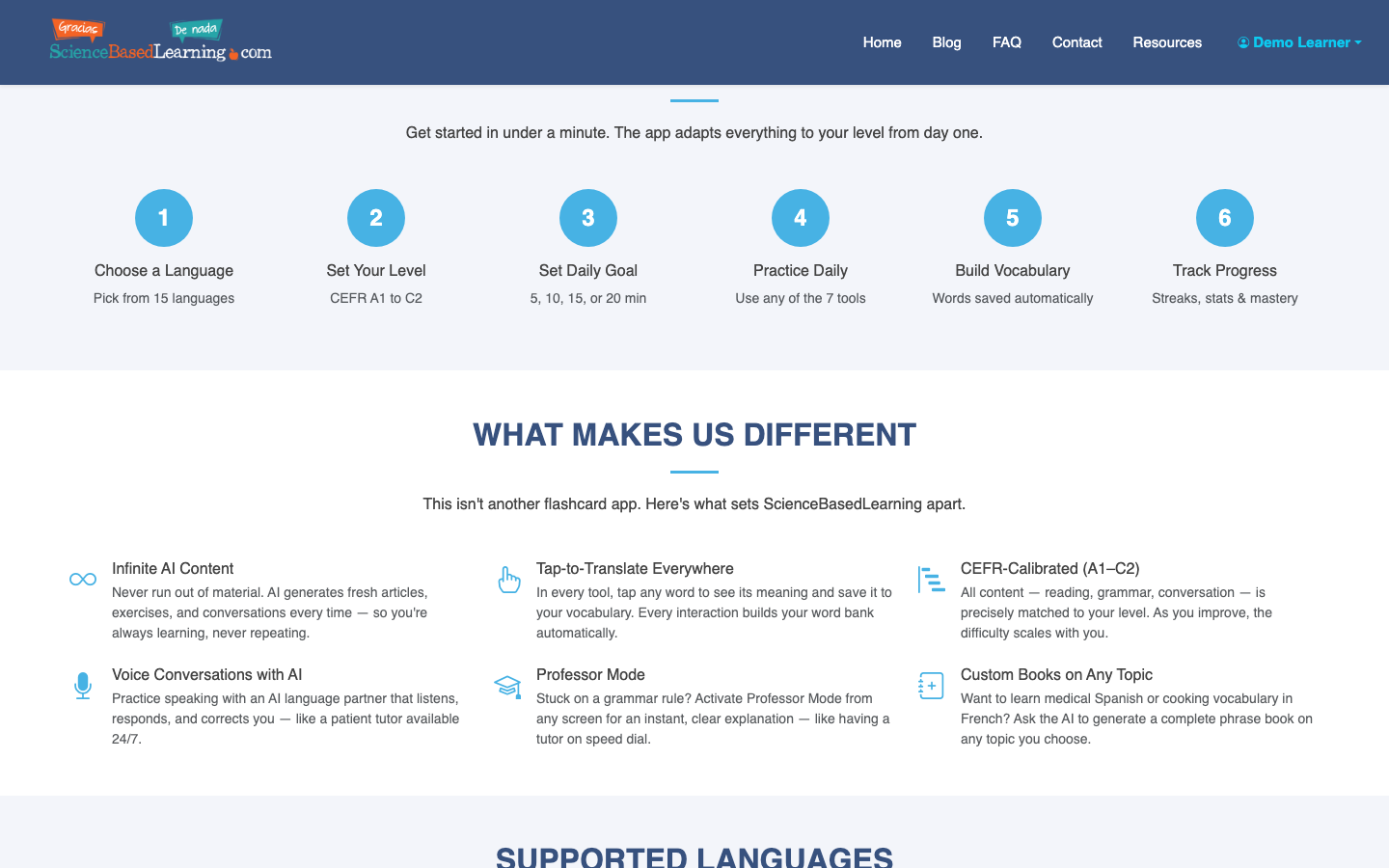
Science Based Learning includes listening drills, pronunciation feedback, AI conversation practice, and daily review tools, so you can build pronunciation into a 10-15 minute routine instead of treating it as a separate chore.
1. Choose the right language and level
Start with material that matches your current level. If the audio is too easy, you will not stretch your ear. If it is too advanced, you will copy rhythm and sounds without understanding what you are saying.
For most learners, A1-A2 pronunciation practice should focus on individual sounds, short phrases, and survival vocabulary. B1-B2 learners should add sentence stress, linking, and natural rhythm. C1-C2 learners should focus on nuance: intonation, reductions, and sounding natural in longer speech.
2. Listen before you speak
Before you repeat a word or sentence, listen to native audio at least three times. On the first listen, focus on meaning. On the second, listen for the stressed syllable or strongest word. On the third, listen for what is not pronounced the way you expected.
This matters because many pronunciation mistakes begin as listening mistakes. English speakers learning Spanish may miss the difference between a tapped r and a rolled rr. Korean learners may struggle to hear tense consonants. French learners often need time to hear vowel distinctions that do not exist in English.
In Science Based Learning, listening drills with native audio are useful before pronunciation feedback because they give you a clean model to imitate.
3. Shadow short phrases, not isolated words only
Single-word practice helps, but real pronunciation happens inside phrases. Sounds change depending on what comes before and after them. Rhythm also becomes easier when you copy whole chunks.
Use this pattern:
- Listen to a phrase once without speaking.
- Play it again and whisper along.
- Play it a third time and speak at normal volume.
- Repeat without audio and compare how it feels.
Keep phrases short: 3-8 words is enough. A useful phrase might be “I would like coffee,” “Where is the station?” or “I have a question.” Once those feel natural, expand to full sentences.
4. Record yourself and compare one detail at a time
Recording yourself can feel uncomfortable, but it is one of the fastest ways to improve. The mistake is trying to judge everything at once. Instead, choose one target per recording.
Examples:
- Did I stress the correct syllable?
- Did I pronounce the final consonant?
- Did my vowel sound match the native audio?
- Did my pitch rise or fall naturally?
- Did I pause in the same place as the speaker?
If you use pronunciation feedback in Science Based Learning, treat the score or correction as a signal, not a verdict. Repeat the phrase, adjust one feature, and try again. Three careful attempts are more useful than fifteen rushed ones.
5. Use minimal pairs for stubborn sounds
If you keep asking, “how do I improve my pronunciation when I cannot even hear the difference?”, minimal pairs are the answer. Minimal pairs are words that differ by one sound, such as ship/sheep in English or pero/perro in Spanish.
Pick two sounds that confuse you. Listen, repeat, and test yourself. The aim is to train your ear first, then your mouth. Once you can reliably hear the difference, pronunciation becomes much easier.
Useful minimal-pair practice looks like this:
- 2 minutes listening only
- 3 minutes repeating pairs
- 3 minutes using each word in a short phrase
- 2 minutes reviewing the hardest examples tomorrow
6. Bring pronunciation into conversation
Pronunciation practice should not stay trapped in drills. Once you can say a word clearly in isolation, use it in conversation. AI conversation practice can help here because you can repeat common phrases without the pressure of a live conversation.
Choose one pronunciation focus per conversation session. For example, if you are learning French, you might focus on nasal vowels. If you are learning Japanese, you might focus on pitch and clean syllable timing. If you are learning Portuguese, you might focus on vowel reduction and rhythm.
7. Review the same sounds over several days
Pronunciation does not usually change permanently in one sitting. You need spaced repetition, especially for sounds your first language does not use.
A simple weekly structure works well:
- Monday: learn and record 5 target words
- Tuesday: review those words in phrases
- Wednesday: use them in conversation practice
- Thursday: repeat the hardest 2-3 items
- Friday: record a short paragraph
- Weekend: light review only
This is where daily review streaks and spaced-repetition flashcards help. You are not just memorizing vocabulary. You are reminding your ear and mouth how the language should feel.
For a broader study plan, see How to Learn a Language Fast. If you are focused on Spanish specifically, How to Learn Spanish Fast pairs well with this pronunciation routine. Korean learners can also use the language-specific guidance in How to Learn Korean Fast.
What good pronunciation progress looks like
Do not measure progress only by whether you “sound native.” Better signs include:
- Native speakers ask you to repeat yourself less often.
- You can hear mistakes you used to miss.
- Your mouth finds difficult sounds faster.
- You can keep clearer pronunciation during conversation.
- You feel less tired after speaking.
A realistic target is 10 minutes of pronunciation-focused work, 4-5 days per week. After two weeks, most learners notice better awareness. After six to eight weeks, common phrases usually become clearer and more automatic.
Common mistakes to avoid
The biggest mistake is practicing too broadly. “Improve my accent” is too vague. “Fix the Spanish r in short phrases” is trainable.
Another mistake is reading silently and expecting speaking to improve. Reading helps vocabulary and grammar, but pronunciation needs sound and movement. Use graded texts for comprehension, then read a few lines aloud and compare them to native audio when available.
Finally, avoid switching targets every day. If German ch sounds are difficult, stay with them for a week. If Mandarin tones are unstable, give them focused attention across multiple sessions. Pronunciation rewards repetition more than novelty.